

Testing the Math: Do Progressive Roulette Systems Actually Work?
Progressive betting systems promise to beat a game that is mathematically designed to be unbeatable. The question isn’t whether they work — they don’t — but how and when they fail, and what that means for the size of bankroll you bring to the table. This article works through the actual numbers behind the three most common systems, the specific mechanics that break them, and what a player can realistically do to minimise losses instead.
Research Before You Play
First things first, we always recommend reading up on some basic strategy before you start playing any real money casino games. When comparing various roulette systems for uk players, it becomes clear that no mathematical strategy alters the fundamental house edge, but some are much better suited for preserving a small bankroll than others. The variables worth checking before you sit down or log in: the specific wheel variant (European, French, or American), the table minimum and maximum for even-money bets, whether La Partage or En Prison rules apply, and what your bankroll supports under the system you’re using. These four pieces of information determine the realistic ceiling on your session, and take under a minute to confirm.
One thing to watch on UK online casinos: some tables labelled “European” use non-standard maximums that are unusually low relative to the minimum (e.g., £1 min / £100 max). These tables are effectively Martingale-proof after seven losses. If you’re using any doubling system, check the max before you buy in.
The House Edge, and Why It’s Non-Negotiable
Before looking at any system, fix the baseline. European roulette has 37 pockets (1–36 plus a single zero). An even-money bet like red/black pays 1:1 but wins on only 18 of 37 pockets, giving the house a 2.70% edge. American roulette adds a double zero, taking the edge to 5.26%. French roulette with
La Partage — where even-money bets return half the stake when zero hits — drops the edge to 1.35%, the lowest you’ll find on the game.
That edge is the cost per unit wagered, averaged over enough spins. No sequence of bets changes it. If you wager £10,000 total across a session on European roulette, your expected loss is £270 regardless of how you distributed those bets. This is the number that every system has to contend with, and none of them do.
Practical takeaway: If you have a choice, play French roulette with La Partage or En Prison rules. You’ll halve your expected loss compared to standard European, and cut it by a factor of four versus American. Most UK online casinos offer at least one French variant.
The Martingale: Where It Breaks
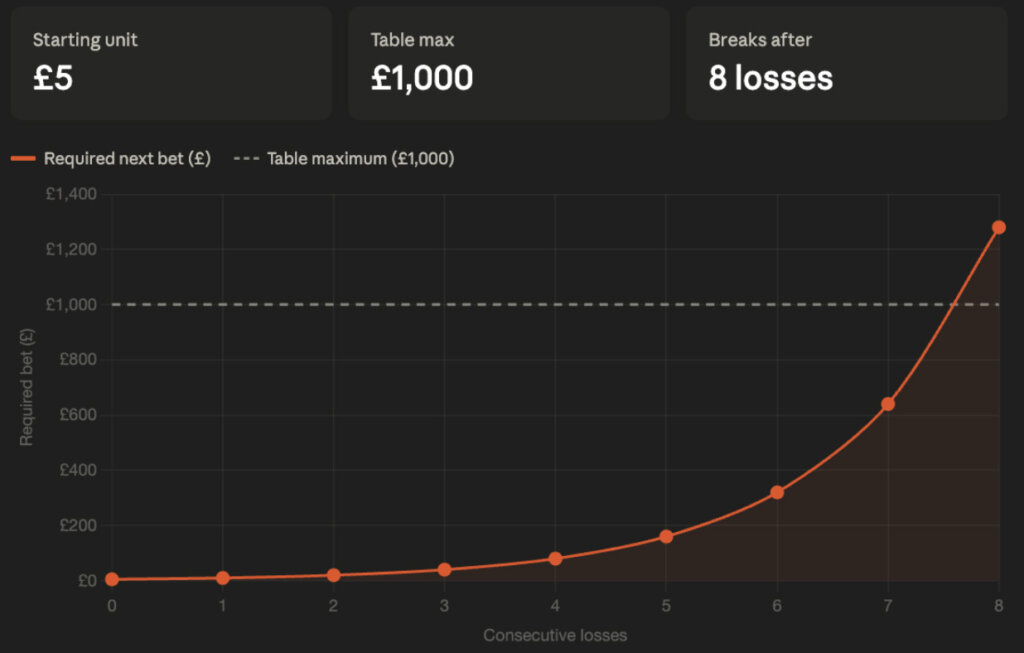
The Martingale doubles your bet after each loss on an even-money wager. One win recovers all previous losses plus one unit of profit.
The system breaks at the table limit, and the break happens faster than most players expect. Here’s what the bet size looks like starting from £5:
| Consecutive losses | Next bet | Cumulative loss |
| 0 | £5 | £0 |
| 1 | £10 | £5 |
| 2 | £20 | £15 |
| 3 | £40 | £35 |
| 4 | £80 | £75 |
| 5 | £160 | £155 |
| 6 | £320 | £315 |
| 7 | £640 | £635 |
| 8 | £1,280 | £1,275 |
A typical UK online roulette table with a £5 minimum has an even-money maximum between £500 and £1,000. That gives you seven or eight doublings before the system physically cannot continue.
The probability of eight consecutive losses on European even-money bets is (19/37)^8 = 0.53%, or roughly 1 in 188. That sounds rare. It isn’t. A player averaging 60 spins per hour will hit an eight-loss streak roughly every three hours of play. Every time they do, they lose the entire £1,275 — and the ~188 one-unit wins preceding it (£940 in profit) don’t cover it.
Practical takeaway:
If you’re going to use Martingale at all, calculate your “ruin point” before you start. Take the table’s maximum even-money bet, divide by your starting unit, and count how many doublings that allows. If the answer is under 10, you will hit that wall within a few sessions of regular play.
The Fibonacci: A Slower Curve, Same Destination
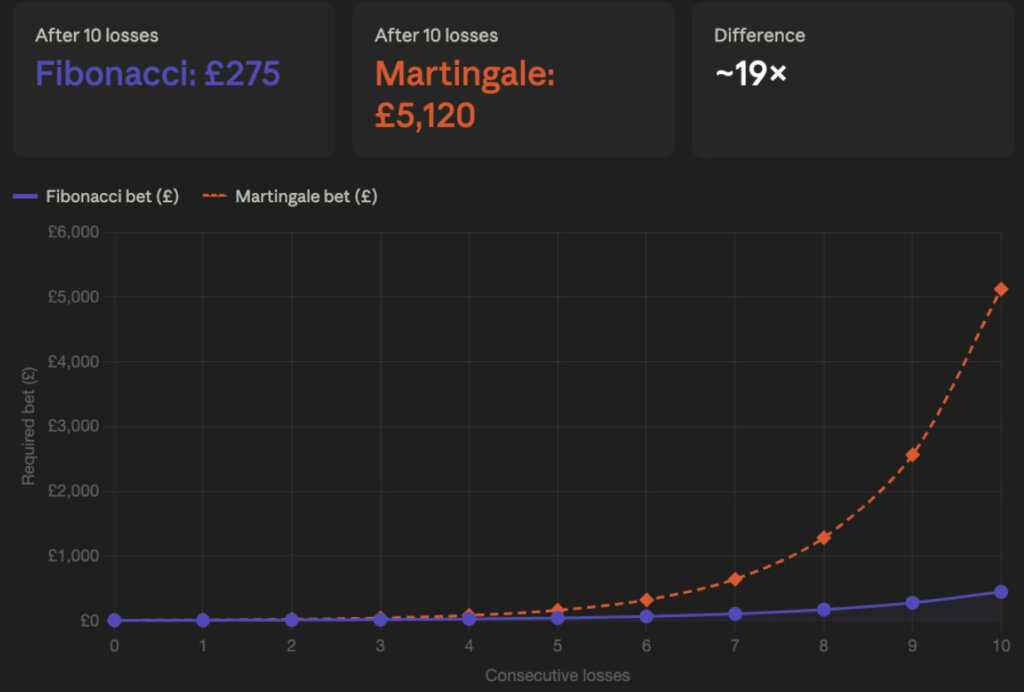
bets units in the sequence 1, 1, 2, 3, 5, 8, 13, 21, 34, 55, 89. Move one step forward after a loss, two steps back after a win. Unlike Martingale, a single win does not recover all prior losses — you claw back gradually.
After ten consecutive losses, a Martingale player is staking 1,024 units (£5,120 from a £5 base). A Fibonacci player is staking 55 units (£275). That’s the selling point.
The trade-off: because wins only recover partial losses, Fibonacci keeps you at the table longer. And time at the table is the variable most directly linked to total loss. Using the expected loss formula (edge × total wagered), a player grinding a Fibonacci session over four hours at 60 spins per hour with an average bet of £15 wagers £3,600 total, for an expected loss of £97 on European roulette. The same session on Martingale, with catastrophic streaks factored in, has higher variance but often a similar or worse expected loss because the bet sizes during losing runs are much larger.
Practical takeaway:
Fibonacci is “safer” only in the sense that individual sessions are less likely to blow up. The cumulative expected loss across many sessions is no better, and can be worse if the gentler pacing keeps you playing longer.
The D’Alembert: The Gentlest Option
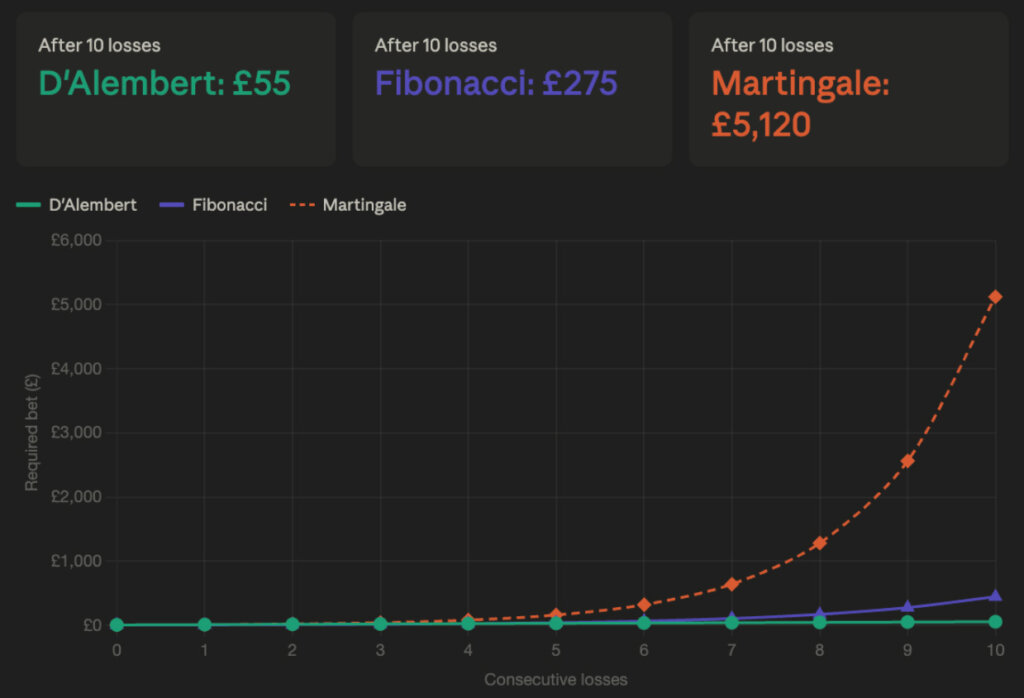
D’Alembert’s arithmetic progression keeps bet sizes manageable even on long losing streaks. It still loses to the house edge over time — but it won’t wipe out a session in a single bad run.
The D’Alembert adds one unit after a loss, subtracts one unit after a win. After ten consecutive losses, you’re betting 11 units, not 1,024 and not 55. For a recreational player, this is by far the least destructive of the three.
It still doesn’t beat the edge. But the variance is so much lower that on a modest bankroll (say, 100 units), you can typically play a full session without hitting ruin on any realistic losing streak. A 15-loss run — probability around 0.00006% per sequence — only scales you up to 16 units.
Practical takeaway:
If discipline rather than profit is the goal, D’Alembert is the progression system that does the least damage. It won’t win, but it won’t produce the kind of single-session wipeout that Martingale eventually will.
Bankroll Sizing: The Numbers Most Players Skip
If you’re playing a session, here’s what the math says about bankroll size relative to system choice. Assume a £5 unit, European roulette:
- Flat betting: 40 units (£200) supports roughly 2 hours of play with very low risk of ruin.
- D’Alembert: 60 units (£300) handles most realistic losing streaks.
- Fibonacci: 150 units (£750) to absorb a 10-loss streak without forced stop.
- Martingale: 255 units (£1,275) to survive 8 consecutive losses, which you will see within a few sessions.
The Martingale requires, bluntly, a bankroll that makes the £5 unit feel absurd. Players rarely size their bankroll this way, which is why most Martingale sessions end with the player ignoring the system on the critical spin and taking the loss early.
What Actually Works
Two practices demonstrably reduce losses across long-run play:
- Loss limits set before the session.
Decide the number before you log in. When you hit it, stop. A loss limit of 40% of your session bankroll is aggressive but survivable; 25% is more conservative.
- Win targets.
Less intuitive but equally important. Players who keep going after hitting a win target almost always give it back, because expected value is negative on every additional spin. A target of 50% profit on your buy-in is realistic; anything higher becomes statistically harder to reach without also hitting the loss limit first.
These two rules, applied consistently, do more to preserve a bankroll than any progression system ever will. They don’t promise wins — nothing in roulette does — but they cap the damage, and capping the damage is the only lever available to a player at a game with a fixed negative edge.
Roulette is a game with known math. The systems don’t beat the math. The player who accepts that and focuses on session discipline ends up further ahead, over time, than the one still searching for the sequence that works.