
How Slot Machines Are Really Designed, From Mathematical Model to Casino Floor
- Every slot machine is built around a fixed mathematical model, which controls RTP, volatility, win frequency, and maximum payouts long before any graphics or sound are created.
- The spinning reels are purely visual, the outcome of each spin is determined instantly by a Random Number Generator, ensuring every result is independent and random.
-
Before reaching UK arcades, casinos, or online platforms, every slot must pass strict independent testing and UK Gambling Commission certification to ensure fairness and compliance.
Every slot machine starts as a simple idea. What eventually appears in a UK arcade, bookmaker, or online casino has usually taken months, and sometimes years, to develop. Behind every game is a team of specialists, including mathematicians, programmers, artists, sound engineers, and independent testing laboratories.
Companies such as Light & Wonder, Inspired Gaming, Playtech, Novomatic, and Pragmatic Play invest significant time and resources into each release. What looks like a simple spinning game is actually a carefully engineered system where every detail has been planned long before the first player presses spin.
It begins with a theme and gameplay idea
The first stage is deciding what the slot will be about. This might sound straightforward, but it shapes everything that follows. Developers want something familiar enough that players instantly understand it, but distinctive enough that it stands out among hundreds of other machines.
Themes often follow popular formats because players already recognise and enjoy them. Common examples include:
-
Fishing themes, such as Fishin’ Frenzy
-
Adventure and treasure themes, such as Book of Dead by Play’n GO
-
Irish themes, such as Rainbow Riches by Light & Wonder
-
Mechanic driven themes, such as Megaways
At this stage, developers define the core identity of the game. They decide things like:
-
The visual style and atmosphere
-
The type of player they are targeting
-
How frequently the game should pay wins
-
How exciting or volatile the gameplay should feel
-
What kind of bonus features will exist
This stage acts as the blueprint for everything that follows. Once this direction is set, the technical design begins.
The mathematical model is built first, and it controls everything
Before any artwork or sound is created, the most important part of the slot is designed, the mathematics. This is handled by specialist gaming mathematicians, whose job is to determine exactly how the machine will behave over time.
They define several critical elements:
-
RTP, Return to Player percentage, which determines the average long term payout
-
Hit frequency, how often the player wins anything at all
-
Volatility, whether wins are small and frequent, or rare but large
-
Bonus feature probability, how often bonus rounds occur
-
Maximum win potential, the largest possible payout the slot can produce (usually £500, but online can vary significantly).
This mathematical model is the foundation of the entire game. It is created first because everything else must follow it.
For example, a high volatility slot like X Coin Blitz is deliberately designed to pay less often, but when it does, the bonus features can produce much larger wins. A lower volatility slot does the opposite, it gives smaller wins more regularly, creating a smoother experience.
Once this mathematical structure is approved, it is locked. The rest of the development process builds around it.
Software developers build the game and integrate the RNG
Once the maths is complete, software developers begin building the actual game. They create the code that controls everything the player sees and interacts with.
At the heart of the system is the Random Number Generator, usually called the RNG. This is the component that ensures every spin is random and independent.
The RNG works continuously, generating thousands of random numbers every second. When the player presses spin, the system instantly selects one of those numbers. That number corresponds to a specific reel position, which determines the outcome.
The spinning reels you see on screen are simply an animation that reveals the result that was already determined.
This same principle applies to all modern machines, whether they are made by Novomatic, Playtech, Inspired Gaming, or any other licensed provider.
Visuals and sound are added to create the experience
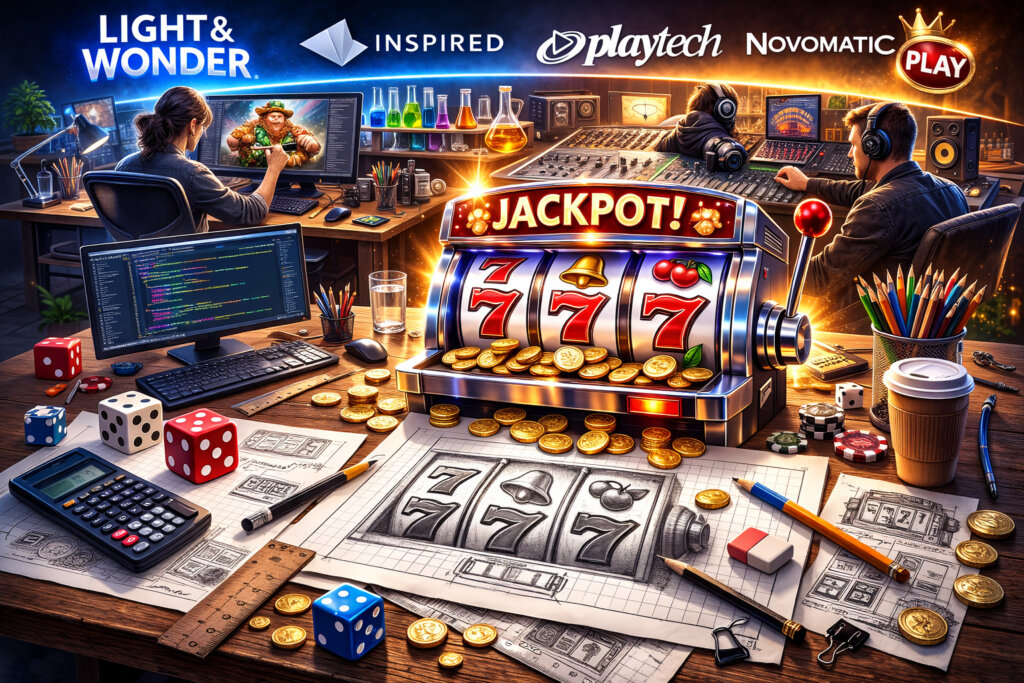
Once the technical foundation exists, artists and sound designers bring the game to life. This stage transforms the mathematical system into something engaging and entertaining.
This includes creating:
-
Symbol artwork
-
Character designs
-
Animations
-
Background environments
-
Bonus feature visual effects
-
Sound effects for wins and spins
-
Music and atmosphere
Sound and visuals play a huge role in how the game feels. Even small wins are accompanied by satisfying sounds and animations, which makes the experience more enjoyable.
Modern slot machines are closer to video games than traditional mechanical machines. The goal is to create an immersive experience that keeps players engaged.
Bonus features are designed as part of the mathematical structure
Bonus features are not random additions, they are built directly into the mathematical model from the beginning. In many slots, a large portion of the total RTP is delivered through bonus rounds rather than base game wins.
Common bonus features include:
-
Free spins rounds
-
Expanding wild symbols
-
Collect features
-
Hold and spin jackpot features
-
Progressive jackpot integrations
-
Reel modifiers, such as Megaways changing reel sizes
These features are carefully balanced so they create excitement while still maintaining the intended RTP and volatility.
Every slot must pass strict independent testing before release
Before any slot machine can be released in the UK, it must undergo independent testing and certification. This ensures the game is fair, random, and compliant with regulations.
Testing laboratories verify several key areas:
-
RTP accuracy, ensuring it matches the designed percentage
-
RNG randomness, confirming outcomes are genuinely random
-
Fairness, ensuring no hidden manipulation exists
-
Compliance with UK Gambling Commission regulations
This process applies to all major providers. Without certification, the game cannot legally be deployed. Once approved, the slot is ready to be released.
For physical UK machines, this means installing the game onto licensed terminals. For online slots, the game is uploaded to casino platforms. The mathematics remains exactly the same, only the interface differs.
Whether played online or in person, the underlying system behaves identically.
Developers monitor performance, but the behaviour never changes
After release, developers monitor how the game performs. They analyse data such as:
-
How often players trigger bonus features
-
How long players spend on the game
-
How popular the slot becomes
-
Overall engagement levels
This helps them design better future games. However, the mathematical model of an individual slot does not change after release. The RTP, volatility, and probabilities remain fixed unless pulled and re-released.
Each spin remains completely independent and random.
What looks simple is actually highly engineered
Modern slot machines combine multiple specialised fields, including mathematics, software engineering, visual design, and regulatory compliance. Every symbol, sound, and feature has been deliberately designed and tested.
By the time a slot appears on a casino floor or arcade terminal, it has gone through:
-
Mathematical design and probability modelling
-
Software development and RNG integration
-
Visual and sound production
-
Independent testing and certification
-
Regulatory approval
What appears to be a simple spinning game is actually the result of highly sophisticated engineering. The only thing left to chance is the outcome of each individual spin, which is determined randomly by the RNG.