
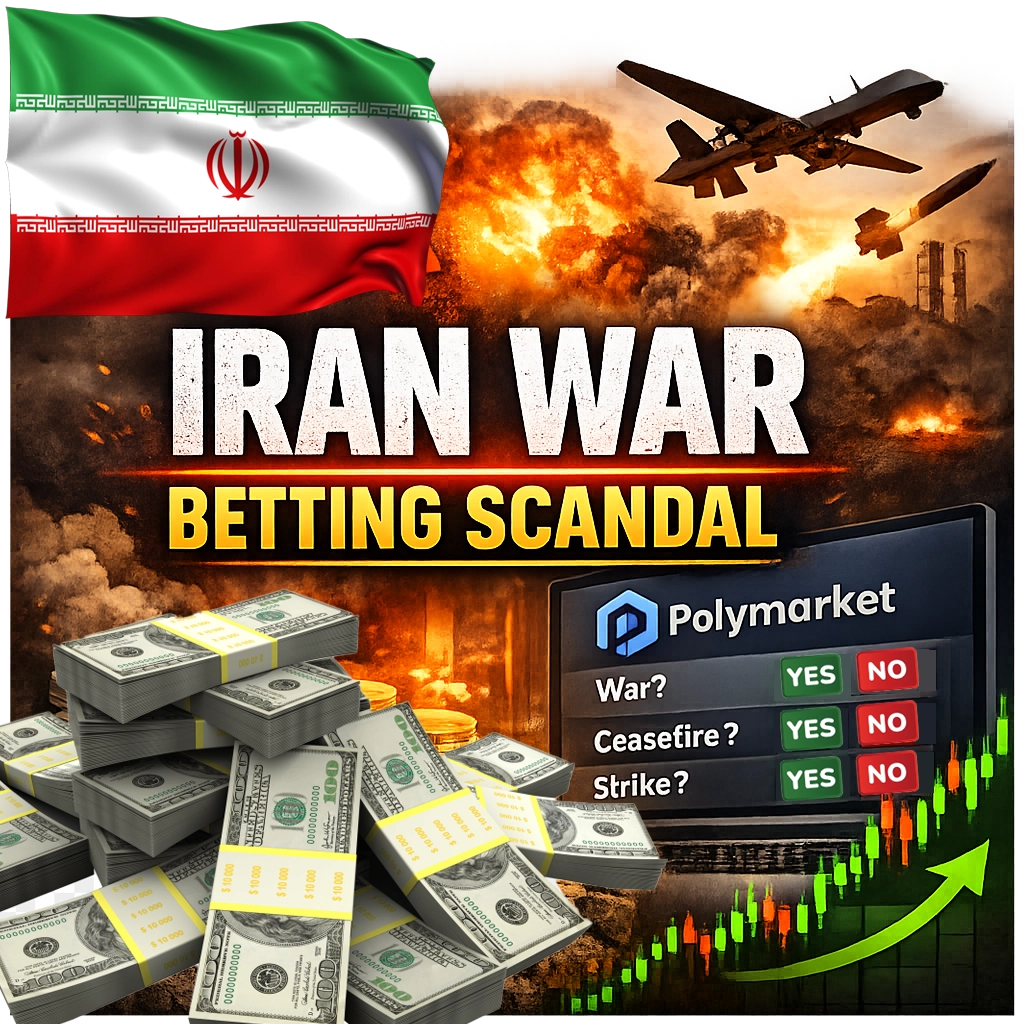
Iran War Betting Surge: The Trades That Moved Before the News
-
Massive bets were placed minutes before key Iran-related announcements, lining up almost perfectly with market-moving news
-
Both oil markets and prediction platforms like Polymarket showed highly accurate, well-timed positions
-
The scale and precision of these trades suggest potential multi-million profits from near-instant market reactions
In the days surrounding the latest escalation involving Iran, attention has shifted away from the geopolitical headlines themselves and onto something far more unusual happening in parallel, the behaviour of betting and financial markets in the minutes leading up to key announcements. What initially looked like sharp trading quickly began to stand out as something far more precise, with large sums of money being committed to very specific outcomes just before they became public knowledge.
A number of these bets appeared across both traditional financial markets and newer prediction platforms such as Polymarket. On the financial side, traders placed hundreds of millions of dollars into oil positions moments before announcements that would predictably move prices. In one widely discussed example, roughly half a billion dollars was positioned ahead of news that led to a sharp drop in oil prices. The timing was so tight that it left very little room for coincidence, particularly given how quickly the market reacted once the information became public.
At the same time, prediction markets were showing similarly precise movements. These platforms allow users to place real money on the likelihood of real world events, ranging from elections to conflicts. In this case, markets were active on whether military action would occur, whether it would be delayed, and whether a ceasefire would be announced within a certain timeframe. What stood out was not just the direction of the bets, but how concentrated and confident they were immediately before the relevant news broke.
Some individual accounts drew particular attention. Certain traders managed to correctly position themselves ahead of multiple developments, including the initial escalation and then subsequent signs of de escalation. In isolation, a correct call might be dismissed as luck or strong analysis, but repeated accuracy across separate, time sensitive events made the pattern harder to ignore. These accounts often entered positions shortly before the odds shifted dramatically, allowing them to capture value that disappeared almost instantly once the news became public.

There were also signs that activity may not have been coming from a single source. Analysts pointed to behaviour consistent with funds being split across multiple wallets or accounts, a common tactic used to disguise the true size of a position. Instead of one large, obvious bet, the same exposure could be built through a series of smaller trades, reducing visibility while still capturing the same upside. When viewed collectively, these patterns suggested coordination rather than isolated decision making.
The scale of the potential profits adds another layer to the story. In oil markets, even a relatively small price movement can generate enormous returns when leveraged across positions worth hundreds of millions. A well timed move ahead of a sharp drop or spike could easily result in gains in the tens of millions within a very short window. On prediction markets, where odds can shift from low probability to near certainty in seconds, early entrants could multiply their stake several times over, especially if they committed significant capital before the wider market caught up.
This is not the first time that this kind of activity has been observed around major geopolitical events. Similar patterns have been noted in earlier Iran related developments and in other regions where sudden announcements have a direct and immediate impact on markets. Each instance adds to a growing sense that, at the very least, certain participants are operating with a level of timing and confidence that goes beyond conventional analysis.
What makes this situation particularly striking is how the two worlds, traditional finance and decentralised prediction markets, appear to be moving in sync. Large scale oil trades and highly targeted event bets both pointed in the same direction at almost the same time, reinforcing the idea that whatever information was being acted upon was both specific and actionable. Whether that came from exceptional interpretation of signals or something more direct remains the central question, but the consistency of the timing is what continues to drive scrutiny.
For now, the focus remains on understanding how these trades were placed so precisely, and whether the pattern represents a new reality of hyper informed markets or something that crosses into territory markets are not designed to handle. Either way, the combination of speed, scale, and accuracy has made this one of the more closely watched intersections of global events and speculative trading in recent years.