
Why Some UK Roulette Machines Have 1, 2, 3, Or Even 4 Zeros (And What It Does To Your Odds)
- Each extra zero dramatically increases the house edge, rising from just 2.7% on single-zero roulette to a massive 10% on four-zero pub machines.
- The payouts stay exactly the same, but the odds get worse, meaning players lose more money over time without realising it.
- Four-zero roulette is the worst version available in the UK, designed to remain profitable even with lower £100 jackpot limits in pubs.
If you’ve ever played roulette in an arcade, bookies or pub, you might have noticed something slightly odd without realising how important it is. Some machines don’t just have a single zero. Some have two, some have three, and many pub machines actually have four zeros on the wheel.
At first glance, everything looks completely normal. The layout is the same, the numbers run from 1 to 36, and the payouts appear identical to what you’d expect in a casino. You can still bet on red or black, odd or even, or individual numbers, and the winnings look familiar. But underneath the surface, the maths is very different, and those extra zeros make a huge difference to your chances of winning.
In fact, a four-zero roulette machine has nearly four times the house edge of the traditional single-zero roulette you’d find in a casino. The game hasn’t been rigged or tampered with, but it has been designed in a way that gives the operator a much larger built-in advantage.
Why Zero Exists At All
To understand why, it helps to look at why the zero exists in the first place.
If roulette only had the numbers 1 to 36, it would actually be a perfectly fair game. There would be 36 possible outcomes, and the payouts would match the true odds exactly. Over time, neither the player nor the casino would have any advantage, and the casino wouldn’t make any money from running the game.
The zero exists purely to create that advantage.
When you bet on a single number, the machine pays 35 to 1. That sounds fair, but if there are actually 37 possible outcomes, numbers 1 to 36 plus the zero, your true odds of winning are 36 to 1 against. That small difference between the true odds and the payout is where the casino makes its profit. It’s built into the game itself, and it guarantees that over time, the operator will come out ahead.
With just one zero, the house edge is relatively small. But every additional zero increases the number of losing outcomes without increasing the payout, which makes the game progressively worse for the player.
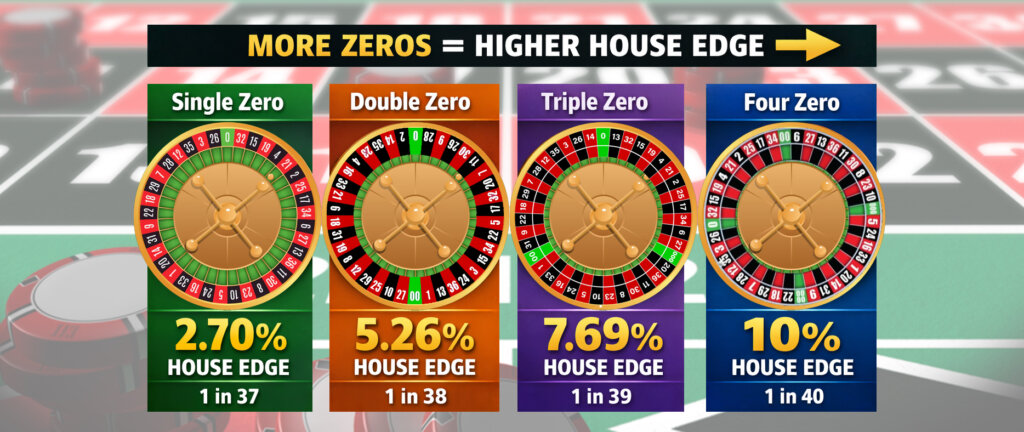
Traditional European roulette, which is the standard in most UK casinos, has just one zero. That creates 37 possible outcomes in total. Because the payouts remain at 35 to 1, this results in a house edge of 2.7%. In simple terms, for every £100 wagered over a long period of time, the casino keeps around £2.70 on average. That’s considered relatively low compared to most other gambling games, especially slot machines, which often have house edges of 4% to 10% or more.
This is why experienced players generally prefer single-zero roulette whenever they have the option. It’s one of the most favourable mainstream games available from a mathematical perspective.
However, many roulette machines outside casinos don’t use a single zero.
FOBT Roulette
In betting shops, roulette machines, including FOBTs supplied by companies like Inspired Gaming and Light & Wonder often use two zeros instead. This increases the total number of possible outcomes to 38, but the payout remains exactly the same at 35 to 1. That small change nearly doubles the house edge to 5.26%. The spin bar and pie bar which are commonly found in arcade and bookies FOBT roulette, don’t effect the odds, they just make for a more volatile game to increase the bet size on the actual roulette table.
The game still looks identical, and most players wouldn’t notice any difference, but mathematically it’s significantly worse.
In arcades, the situation can be even more extreme. Some machines now use three zeros, increasing the total number of outcomes to 39 while still paying only 35 to 1. This pushes the house edge up to 7.69%, which makes it almost three times worse than traditional casino roulette.
But the most extreme version is usually found in pubs.
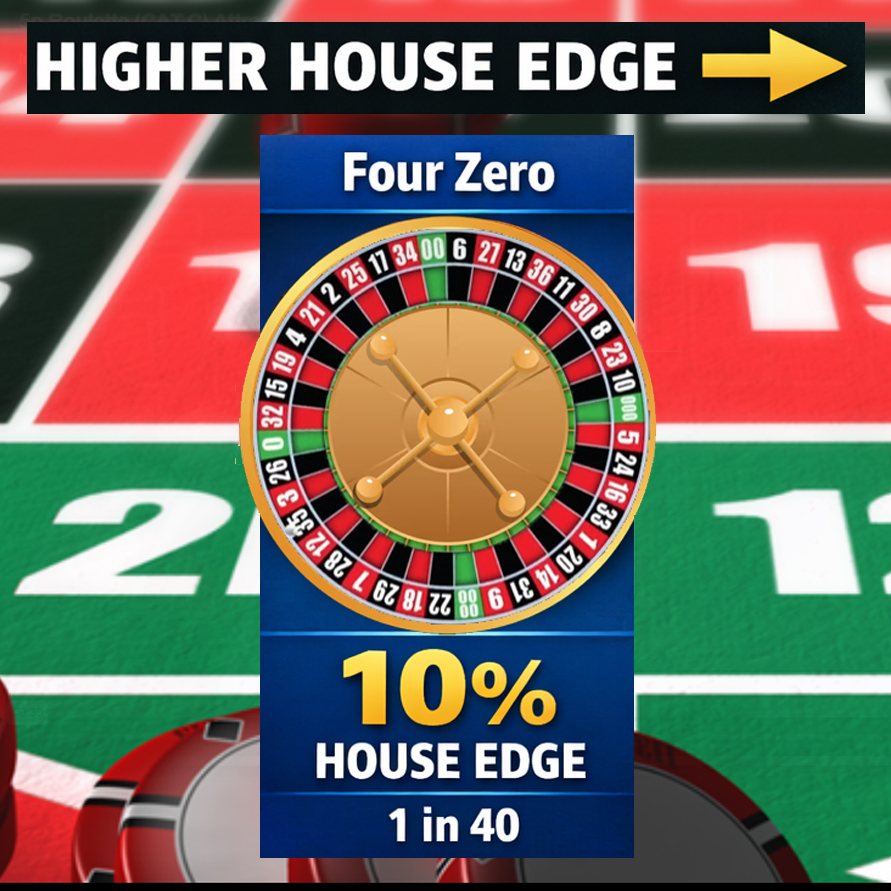
Many pub roulette machines, particularly the £100 jackpot terminals supplied by manufacturers like INSEinc, use four zeros. This creates 40 possible outcomes, while still paying only 35 to 1 on a winning number. The result is a house edge of 10%.
That means for every £100 wagered over time, the machine keeps £10 on average. Compared to the 2.7% edge in a casino, that’s a massive difference. You’re losing money at nearly four times the rate, even though the game looks almost identical.
This isn’t an accident or a hidden trick, it’s a deliberate design decision.
Smaller Jackpots, Worse Odds
UK pub machines are limited by regulation to smaller maximum jackpots, usually £100. Because they can’t offer large prizes to attract players, manufacturers increase the house edge instead to ensure the machines remain profitable. Adding extra zeros is one of the simplest ways to do this, because it doesn’t change the appearance of the game. To most players, it still looks like standard roulette, even though the underlying maths is far less favourable.
Importantly, these machines are not cheating. They operate exactly according to their programming and are regulated by the UK Gambling Commission. The outcomes are still completely random. The difference is simply the built-in advantage created by the extra zeros. More zeros mean more losing outcomes, and because the payouts don’t increase to compensate, the operator earns more money over time.
Most players never notice this, because the game feels exactly the same. The wheel spins the same way, the bets work the same way, and the payouts look familiar. Unless you specifically look at how many zeros are on the wheel, you might never realise you’re playing a version with much worse odds.
Hiding the Odds with Bonus Features & ‘Golden Odds’
Modern machines also include additional features that can make the game feel more exciting and, in some cases, give the impression that your chances have improved. Features like Golden Odds, Super Odds, 20p Boost Roulette and bonus wheels are very common on UK roulette terminals in bookmakers and arcades.
These features might highlight certain numbers, add flashing multipliers, or offer occasional boosted payouts. For example, a machine might highlight a “golden number” and pay 50 to 1 if it lands, instead of the usual 35 to 1. This can make it feel like you’ve been given an advantage or a special opportunity.
But mathematically, nothing has changed.
The machine’s overall house edge remains exactly the same. These boosted payouts are balanced by slightly lower returns elsewhere in the game. In other words, the machine simply redistributes its built-in payout percentage. It doesn’t give you extra value, it just delivers the same value in a different way, hiding a double or triple zero into a varying odds wheel. If you turn off the ‘Golden Odds’ on Golden Odds Roulette, the game adds an additional zero.
Bonus wheels and special spins work on the same principle. The machine effectively sets aside a portion of its payout percentage to fund those occasional bonus moments. When they trigger, they feel like extra rewards, but in reality, they’re already accounted for in the machine’s design. These are fun short-term, and certainly make for better videos when I record for YouTube, but the odds are worse.
The real purpose of these features is to change how the game feels, rather than changing the actual maths. They create more exciting moments, larger occasional wins, and more visual stimulation. This makes the game feel less predictable and more engaging.
Without these features, the house edge would be much easier to notice. Players would see steady, consistent losses over time, reflecting the machine’s built-in advantage. Bonus features help disguise this by creating occasional larger wins, which can make the game feel more balanced than it really is.
In reality, nothing about the odds has improved. The machine is simply delivering its expected payouts in a different pattern.
The presentation has changed, but the maths hasn’t.